
While leading ambitious data teams, and mentoring non-data professionals in data literacy, I have often seen bright minds hesitate to ask questions on topics they felt they “should” know - what they feel might be “stupid questions”.
However, as anybody with teaching experience will tell you, there’s no such thing as a stupid question (provided people are being sincere) and, often, these questions help others in the room. People with teaching experience will also tell you that employing bravery in asking questions is a contagious trait - hear someone raise a question and it becomes slightly easier to follow. And, lastly, people with teaching experience will add that we cannot always rely on this bravery alone to weed out hesitation from the entire group.
How then does one make a group of smart, ambitious and/or high-performing people comfortable to participate fully?
The answers live in the realm of psychological safety and so, allow me to rephrase: How does one ensure psychological safety in smart, ambitious and/or high-performing groups? I have been particularly interested in finding the answers w.r.t the data science world where technical complexity, rapid evolution and competition make people hesitant to reveal knowledge gaps. Let’s break it down.
What is psychological safety?
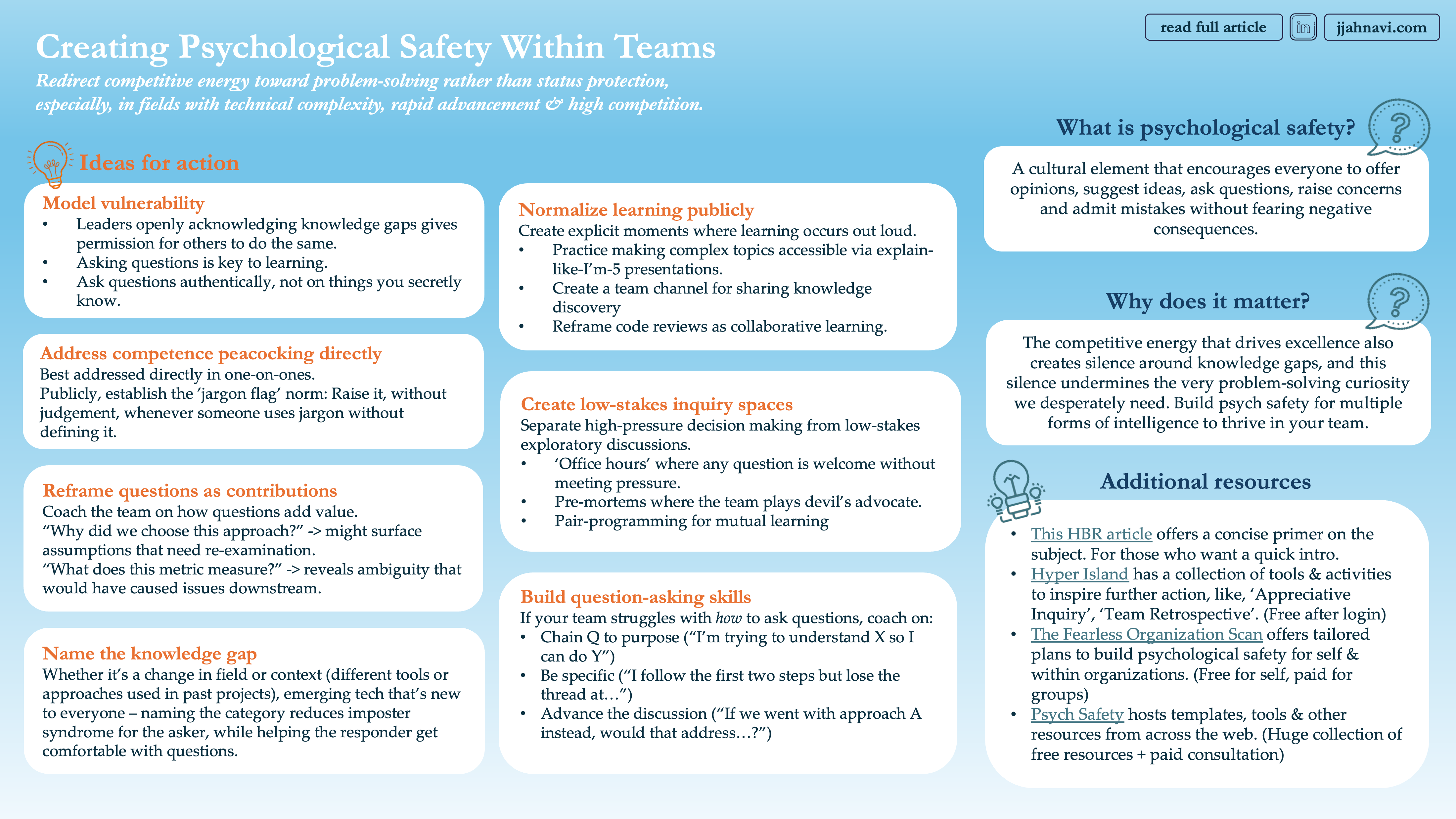
Psychological safety is a cultural ingredient that encourages everyone to offer opinions, suggest ideas ask questions, raise concerns and admit mistakes without fearing negative consequences1.
And why does it matter?
Unfortunately, the competitive energy that drives excellence also creates silence around knowledge gaps, undermining the very problem-solving curiosity we need. This is especially common in fields like data science where technical complexity, rapid evolution and high competition make people hesitant to reveal knowledge gaps.
Why only in smart, ambitious and/or high-performing groups?
Psychological safety is essential for everyone to thrive. My exploration and this article is centered around people who have the the smarts to offer opinions, suggest ideas ask questions, raise concerns but are, sometimes, held back by fear of public disapproval & other such negative consequences.
Why in roles where technical complexity, rapid evolution and competition make people hesitant to reveal knowledge gaps?
Again, it’s the focus I chose, especially w.r.t. my field of data science. It is in such fields that imposter syndrome secretly thrives thanks to the continuous flurry of new information & advancements that threaten to overwhelm anyone that isn’t a practiced disciplinarian or monk.
I fiercely protect my own psychological safety, often distancing myself from environments that threaten it. And while I occasionally do get swept up in the waves of new information, I have been fortunate to have met leaders who made me feel safe to acknowledge the tumble while I climbed back on the surfboard.
From emulating them, scouring through the written words of experts, talking to peers and reflecting on my experiences, I have gradually learnt to embed psychological safety in my teams from the beginning. This has sometimes involved undoing psychological harm among peers transferred from toxic environments. Additionally, scaffolding must be built for each new hire to integrate into the existing environment, challenge the practices and elevate these to better ways of working.
And so when a colleague asked me about this long-running exploration in my work life, I compiled a list that I share here.
1. Good leadership involves modeling vulnerability
First and foremost: It begins with you. When you openly acknowledge your knowledge gaps, it gives permission for others to do the same. Yes, yours is the most impressionable example in your team. When I said things like: “I don’t understand how this algorithm works, can someone please walk me through it?” or “I haven’t worked with this tool before, can someone review my work?”; it liberated others from fear of voicing similar concerns. Now, you can’t pre-empt and emulate every potential question, and you shouldn’t. But asking for help or admitting your mistakes reminds your team of how natural such occurrences can be in a knowledge-intensive, rapidly evolving field like data science. My advice is to do this authentically, not performatively - ask about things you don’t know, not things you secretly do know.
2. Address competence peacocking directly
In ambitious groups, people often compete to appear most knowledgeable - competence peacocking. When this happens, address it directly with your team (or the individuals) on how such dynamic undermines everyone. Remind them that when the team is trying to solve difficult problems, you need everyone’s actual understanding, and not their performance of understanding. Some practical ways to achieve this in teams:
- Establish a ‘jargon flag’: a non-judgmental way to flag anyone using jargon without defining it.
- Demand results: Ask questions like, “what was the measurable outcome?”, “how did this impact the bottom line?” or “what did this help us achieve?” to shift focus from theory to results.
- Reward inclusivity/accessibility: Encourage a team culture where the team praises clarity and the ability to explain complex ideas simply, instead of displaying complex jargon. Rotate ‘explain-like-I’m-five’ presentations to practice making complex topics accessible. This soft skill is especially handy if your work involves collaborating with experts outside your field.
Lastly, include your team in building an accountability practice to snub peacocking tendencies asap.
3. Normalize learning in public
We all have different learning styles that suit us better - usually some combination of private and public learning. For embedding psychological safety in the undercurrents of your team, create explicit moments where learning occurs out loud. This might look like:
- Learning sessions where someone presents a concept they’re currently learning (not mastering). Gerald Weinberg wrote, “Whenever I want to learn something, I arrange to teach a course on the subject. After I’ve taught the course enough to learn something, I write a book.” - From his book, ‘Becoming a Technical Leader’
- A team channel for celebrating knowledge discovery rather than prior knowledge.
- Rotating ‘explain-like-I’m-5’ presentations where people practice making complex topics accessible.
- Code reviews framed as collaborative learning.
4. Reframe questions as contributions
Coach your team on how asking questions adds value to discussions. Questions like “why did we choose this approach?” might surface an assumption that needs re-examination, “what does this metric actually measure?” might reveal ambiguity that would have caused problems downstream. Furthermore, actively thank people for questions that made you think differently or caught something important. Remember how giant a field is for a person to know it all? Let this fact secure you in your knowledge, such that questions become yet another route to learning.
5. Create low-stakes inquiry spaces
Separate high-pressure decision-making from exploratory discussions to create space for addressing inquiries (questions, concerns, alternative ideas). This can take the shape of:
- Set hours where any question is welcome without meeting pressure.
- Pair-programming or pair-analysis with the explicit goal as mutual learning.
- Pre-mortems where the team actively tries to find flaws and gaps in their own thinking - playing devil’s advocate boosts creativity and helps build a thick skin to tackle questions.
- ‘Stupid questions’ slack threads (rebranding the negative framing can work ironically well since owning it reduces its influence).
6. Build question-asking skills
If your team members struggle with how to ask questions, coach on:
- Chaining question to purpose: “I’m trying to understand X so I can do Y.”
- Being specific: “I follow the first 2 steps but lose the thread at …”
- Advancing the discussion: “If we went with approach A instead, would that address …?”
7. Name the knowledge gap
Whether it’s a change in field or context (different tools or approaches used in previous projects), or emerging tech that’s new to everyone – naming the category reduces imposter syndrome for the asker, while helping the responder get comfortable with questions. When someone asks a question, occasionally name which category it falls into.
8. Use the retrospectives
Periodically ask your team: “Which questions did we not ask in this project that we should have, that could have helped us better address downstream issues?” This will helps your team see how unasked questions have consequences. Furthermore, it may also help you identify patterns, mark areas where the group hesitates to ask questions.
Also revisit the tools you have employed to maintain psychological safety thus far: ask them what has worked, what could be improved and what would they like to change altogether.
If you have the resources to build a truly anonymous survey, periodically conduct one on psychological safety. Even in groups with a a good degree of psychological safety, where people are equipped to raise any concerns directly, these surveys will help you catch blindspots: this could be a recent change where communication wasn’t as expected or an influx of new hires creating a sub-conscious team culture evolution. Proactively asking your team is the best way to learn about their psychological safety in the team.
9. Create accountability for psychological safety
Creating psychological safety is your groundwork. Maintaining it is a shared team responsibility, including yours. When someone responds dismissively to a question, address it directly (and privately, if necessary). Conversely, recognize people who are particularly good moderators – good at making space for questions, who make complex topics accessible, who invite alternative view points.
Ultimately, psychological safety isn’t about downplaying true competence. It is about building an environment that enables everyone in your team to take risks, sharpen their competencies, voice opinions, share knowledge without the fear of negative consequences.
If you must take away only three insights, let it be these:
- Psychological safety is created by redirecting competitive energy from individual status protection towards hands-on problem-solving. Address any form of competence peacocking (display without substance) and build accountability within your team.
- No one shoe fits all. Try a few methods of building & maintaining psychological safety and involve your team in the feedback + improvement cycle.
- Psychological safety is like a muscle that needs regular exercise. Periodically reassess & refine your strategies to safeguard this safety.
When a team identity shifts from “we each show our worth” to “we figure things out together”, questions transform from vulnerabilities into essential tools for driving meaningful progress.
Lastly, a few additional resources to further enable you on your journey to building psychological safety in teams:
- Hyper Island has a collection of tools & activities to inspire further action, like, ‘Appreciative Inquiry’, ‘Team Retrospective’. (Free after login)
- The Fearless Organization Scan offers tailored plans to build psychological safety for self & within organizations. (Free for self, paid for groups)
- Psych Safety hosts templates, tools & other resources from across the web. (Huge collection of free resources + paid consultation)
-
This HBR article offers a concise primer on the subject. For those who want a quick intro. ↩